
Roth IRA vs 401(k): Which One Should You Prioritize?
Should you max out your 401(k) or open a Roth IRA first? We explain the tax differences, contribution limits, and the optimal order for most earners.
Roth IRA vs 401(k): Which One Should You Prioritize?
If you have money left over after paying bills, the question of where to put it matters as much as how much you save. The Roth IRA and 401(k) are both excellent retirement vehicles, but they work differently — and understanding those differences can be worth tens of thousands of dollars over a career.
The Core Difference: When You Pay Tax
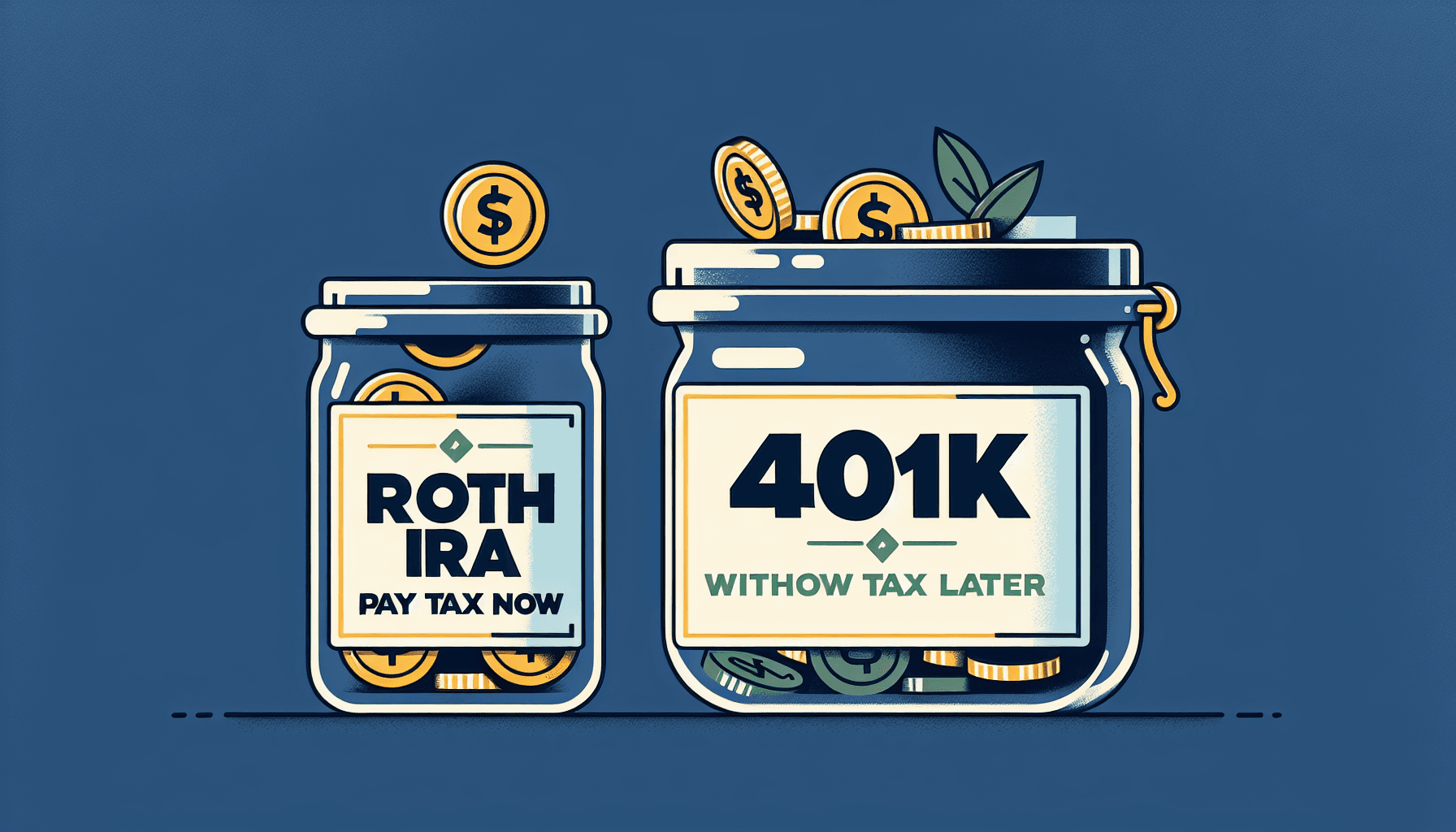
Both accounts grow tax-free once money is inside. The difference is when you pay income tax.
- 401(k): You contribute pre-tax dollars. Your taxable income drops today, and you pay tax when you withdraw in retirement.
- Roth IRA: You contribute after-tax dollars. There's no deduction today, but all growth and withdrawals are completely tax-free in retirement.
The right choice depends on whether you expect to be in a higher or lower tax bracket in retirement than you are today.
401(k) Advantages
Employer match is free money. If your employer matches 50% of contributions up to 6% of salary, that's an immediate 50% return — better than any investment. Always capture the full match before doing anything else.
Higher contribution limits. In 2026 you can contribute up to $24,500 to a 401(k), versus $7,500 to an IRA. If your goal is to stash as much as possible, the 401(k) wins on capacity.
Pre-tax contributions lower your tax bill now. If you're in the 22% or 24% bracket, every $1,000 you put in saves you $220–$240 in federal taxes this year.
Roth IRA Advantages
Tax-free withdrawals in retirement are the Roth's superpower. If you're 25 and invest $7,500 today, and it grows to roughly $57,000 in 30 years at 7%, you owe the IRS nothing when you take it out.
No required minimum distributions (RMDs). Traditional 401(k)s force you to start withdrawing at age 73. Roth IRAs have no such requirement, giving you more flexibility and tax planning options.
Access to contributions anytime. Unlike a 401(k), you can withdraw your contributions (not earnings) from a Roth IRA at any time without penalty. This makes it a flexible emergency backup.
More investment choices. 401(k) plans are limited to what your employer offers. A Roth IRA opened at a brokerage gives you access to any ETF, index fund, or stock.
The Optimal Order for Most People
For the majority of workers, this sequence makes sense:
- 401(k) up to the full employer match — always capture free money first
- Max your Roth IRA ($7,500 in 2026, or $8,600 if 50+) — tax-free growth is hard to beat for younger earners
- Max the 401(k) if you have additional savings capacity ($24,500 limit in 2026)
- Taxable brokerage account for anything beyond the above
When to Deviate
Prioritize the 401(k) first (beyond the match) if:
- You're in a high tax bracket today (32% or above) and expect lower income in retirement
- Your Roth IRA income limit has been hit (single filers and heads of household phase out between $153,000-$168,000 in 2026)
- Your company plan has exceptional low-cost index funds
Lean heavily on the Roth if:
- You're early in your career and in a low tax bracket (10–22%)
- You expect taxes to rise significantly in the future
- You value flexibility and don't want RMDs
The Backdoor Roth: For High Earners
If your income exceeds the Roth IRA limits, you can still contribute via the "backdoor Roth" strategy: make a non-deductible contribution to a Traditional IRA, then convert it to a Roth. It's perfectly legal, but works best if you have no other pre-tax IRA balances.
Key Takeaway
There is no universally right answer — both accounts are powerful. For most people under 40 in the 22% bracket or below, capturing the employer match then maxing a Roth IRA is the optimal order. Use our Retirement Planner Calculator to project exactly what consistent contributions will grow to by your target retirement age.
Disclaimer: This article is for educational purposes only and does not constitute financial advice. Consult a qualified tax advisor for your specific situation.
Share this article
Further Reading
Ready to run the numbers for your situation?
Browse all free calculators →